


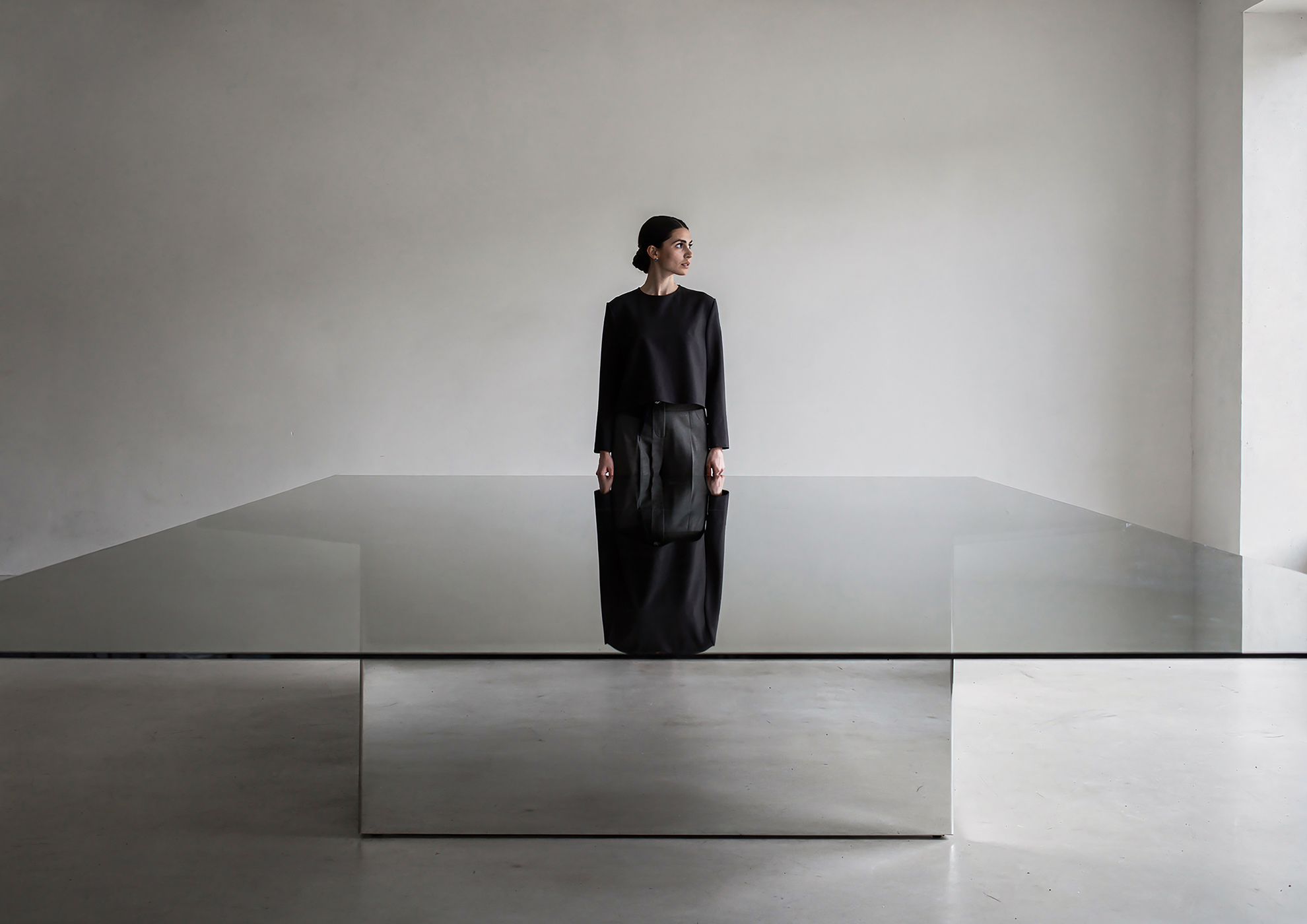
In contemporary design, matter is no longer just color or texture. It's behavior. It's a reaction to light. It is the ability to dialogue with space and with the observer. In this scenario, reflective surfaces return to the center of attention not as a decorative exercise, but as a conscious architectural tool. It's not about nostalgia or stylistic cyclicality: it's about control.
Beyond the 'return of chrome'
Speaking of the 'return of chrome' is a simplification that does not do justice to the complexity of the moment. The chrome that interests architects and designers today is not the brilliant, cold and serial one of the past. It is a surface that works on reflection, not on effect. A skin that measures light, multiplies it, directs it or attenuates it. In other words, an active matter.
Reflection as an architectural language
In contemporary retail, high-profile hospitality and cultural spaces, the reflective surface has once again become a design element. Not to surprise, but to build depth, broaden perceptions, generate continuity. The reflection is not an end, but a means. A medium that requires absolute precision, because every imperfection becomes visible, every discontinuity alters the reading of space.
The role of control
This is where the theme changes dramatically. A mirroring surface does not allow approximations. It does not tolerate random irregularities, ungoverned variations, “wow effect” solutions. Control becomes the real distinctive competence. Background, cycle, uniformity and optical depth control. Without control, reflection becomes noise.
Chrome Mirror as a system
Chrome Mirror was born precisely from this need. Not as an insulated finish, but as a high-precision reflective system. A cycle developed to ensure visual uniformity, stability over time and compatibility with the needs of contemporary architecture. Not a 'chrome effect', but a surface designed to work with light.
Depth and uniformity
Unlike traditional chrome surfaces, Chrome Mirror does not seek glare. Look for depth. The reflection is clear, but never aggressive. The uniformity is total, but not flat. This balance allows applications on large surfaces, vertical elements, complex architectural volumes and large furnishings without loss of perceptual quality.
Architectural applications
In luxury retail, Chrome Mirror becomes a tool for multiplying space without resorting to scenographic devices. In hospitality, it works as an element of continuity and dialogue with opaque and material materials. In architecture, it allows you to build surfaces that react to natural and artificial light in a controlled way, never random.
Chrome and gold: two languages, not two fashions
If gold works on matter, chrome works on light. These are not alternatives, but different tools. The layered, textured and opaque gold builds tactile depth. Controlled chrome builds visual depth. Contemporary design does not choose one against the other: it uses them consciously, depending on the role that the surface must play.
Surface like design skin
Chrome Mirror fits into a vision of the surface as a design skin. A skin that does not cover, but defines. Which does not decorate, but structures the perception of space. In this sense, finishing is not the last step, but a primary design decision.

Replicability and reliability
Another central aspect is replicability. In the contract and architectural fields, a surface must be able to be reproduced consistently on multiple supports, at different times, in different contexts. Chrome Mirror was developed to meet this need, ensuring chromatic and optical stability even in complex productions.
The difference between effect and system
There are many 'mirror effects' in the market. Few reflective systems. The difference lies in the ability to govern the application cycle, not just the immediate visual result. Chrome Mirror was born as a system, because only one system can be prescribed, certified, integrated into a serious architectural project.
Prescription and design
Increasingly, architects and designers are looking for surfaces that can be clearly prescribed, without interpretative ambiguity. Chrome Mirror meets this need by offering a defined, controlled result, consistent with the contemporary design language.
Conclusion
It is not the return of chrome that is of interest to contemporary design. It is the return of reflection as a controlled matter. Chrome Mirror interprets this need by transforming an apparently simple surface into a complex, precise and reliable architectural tool. Because today, more than ever, luxury is control.